Be yourself; Everyone else is already taken.
— Oscar Wilde.
This is the first post on my new blog. I’m just getting this new blog going, so stay tuned for more. Subscribe below to get notified when I post new updates.
We care about you!
Be yourself; Everyone else is already taken.
— Oscar Wilde.
This is the first post on my new blog. I’m just getting this new blog going, so stay tuned for more. Subscribe below to get notified when I post new updates.
You can do many things to help knee pain, whether it’s due to a recent injury or arthritis you’ve had for years.
Follow these 11 dos and don’ts to help your knees feel their best.
Don’t rest too much. Too much rest can weaken your muscles, which can worsen joint pain. Find an exercise program that is safe for your knees and stick with it. If you’re not sure which motions are safe or how much you can do, talk with your doctor or a physical therapist.
Do exercise. Cardio exercises strengthen the muscles that support your knee and increase flexibility. Weight training and stretching do, too. For cardio, some good choices include walking, swimming, water aerobics, stationary cycling, and elliptical machines. Tai chi may also help ease stiffness and improve balance.
Don’t risk a fall. A painful or unstable knee can make a fall more likely, which can cause more knee damage. Curb your risk of falling by making sure your home is well lit, using handrails on staircases, and using a sturdy ladder or foot stool if you need to reach something from a high shelf.
Do use “RICE.” Rest, ice, compression, and elevation (RICE) is good for knee pain caused by a minor injury or an arthritis flare. Give your knee some rest, apply ice to reduce swelling, wear a compressive bandage, and keep your knee elevated.
Don’t overlook your weight. If you’re overweight, losing weight reduces the stress on your knee. You don’t even need to get to your “ideal” weight. Smaller changes still make a difference.
Don’t be shy about using a walking aid. A crutch or cane can take the stress off of your knee. Knee splints and braces can also help you stay stable.
Do consider acupuncture. This form of traditional Chinese medicine, which involves inserting fine needles at certain points on the body, is widely used to relieve many types of pain and may help knee pain.
Don’t let your shoes make matters worse. Cushioned insoles can reduce stress on your knees. For knee osteoarthritis, doctors often recommend special insoles that you put in your shoe. To find the appropriate insole, speak with your doctor or a physical therapist.
Do play with temperature. For the first 48 to 72 hours after a knee injury, use a cold pack to ease swelling and numb the pain. A plastic bag of ice or frozen peas works well. Use it for 15 to 20 minutes three or four times a day. Wrap your ice pack in a towel to be kind to your skin. After that, you can heat things up with a warm bath, heating pad, or warm towel for 15 to 20 minutes, three or four times a day.
Skin cancer develops primarily on areas of sun-exposed skin, including the scalp, face, lips, ears, neck, chest, arms and hands, and on the legs in women. But it can also form on areas that rarely see the light of day — your palms, beneath your fingernails or toenails, and your genital area.
Skin cancer affects people of all skin tones, including those with darker complexions. When melanoma occurs in people with dark skin tones, it’s more likely to occur in areas not normally exposed to the sun, such as the palms of the hands and soles of the feet.
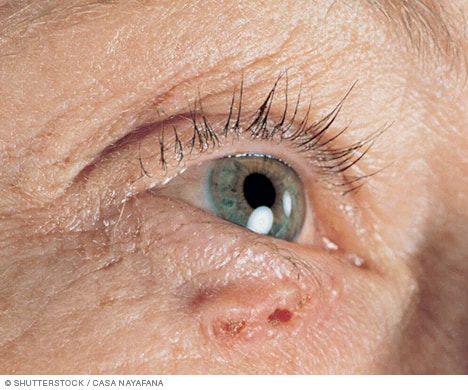
Basal cell carcinoma usually occurs in sun-exposed areas of your body, such as your neck or face.
Basal cell carcinoma may appear as:
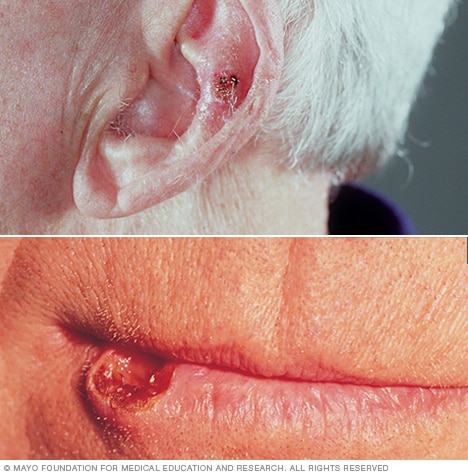
Most often, squamous cell carcinoma occurs on sun-exposed areas of your body, such as your face, ears and hands. People with darker skin are more likely to develop squamous cell carcinoma on areas that aren’t often exposed to the sun.
Squamous cell carcinoma may appear as:
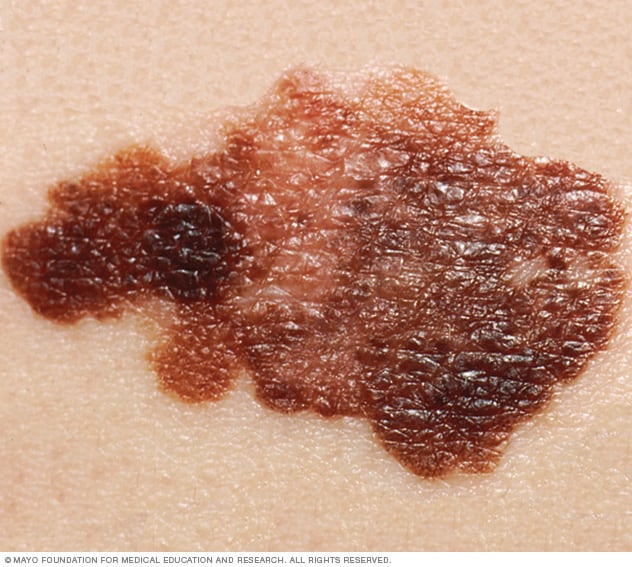
Melanoma can develop anywhere on your body, in otherwise normal skin or in an existing mole that becomes cancerous. Melanoma most often appears on the face or the trunk of affected men. In women, this type of cancer most often develops on the lower legs. In both men and women, melanoma can occur on skin that hasn’t been exposed to the sun.
Melanoma can affect people of any skin tone. In people with darker skin tones, melanoma tends to occur on the palms or soles, or under the fingernails or toenails.
Melanoma signs include:
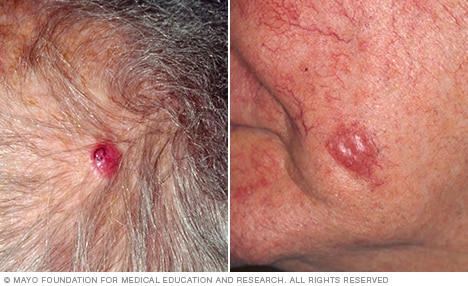
Other, less common types of skin cancer include:
Skin cancer begins in your skin’s top layer — the epidermis. The epidermis is a thin layer that provides a protective cover of skin cells that your body continually sheds. The epidermis contains three main types of cells:
Where your skin cancer begins determines its type and your treatment options.
Much of the damage to DNA in skin cells results from ultraviolet (UV) radiation found in sunlight and in the lights used in tanning beds. But sun exposure doesn’t explain skin cancers that develop on skin not ordinarily exposed to sunlight. This indicates that other factors may contribute to your risk of skin cancer, such as being exposed to toxic substances or having a condition that weakens your immune system.
Factors that may increase your risk of skin cancer include:
Most skin cancers are preventable. To protect yourself, follow these skin cancer prevention tips:
This is an example post, originally published as part of Blogging University. Enroll in one of our ten programs, and start your blog right.
You’re going to publish a post today. Don’t worry about how your blog looks. Don’t worry if you haven’t given it a name yet, or you’re feeling overwhelmed. Just click the “New Post” button, and tell us why you’re here.
Why do this?
The post can be short or long, a personal intro to your life or a bloggy mission statement, a manifesto for the future or a simple outline of your the types of things you hope to publish.
To help you get started, here are a few questions:
You’re not locked into any of this; one of the wonderful things about blogs is how they constantly evolve as we learn, grow, and interact with one another — but it’s good to know where and why you started, and articulating your goals may just give you a few other post ideas.
Can’t think how to get started? Just write the first thing that pops into your head. Anne Lamott, author of a book on writing we love, says that you need to give yourself permission to write a “crappy first draft”. Anne makes a great point — just start writing, and worry about editing it later.
When you’re ready to publish, give your post three to five tags that describe your blog’s focus — writing, photography, fiction, parenting, food, cars, movies, sports, whatever. These tags will help others who care about your topics find you in the Reader. Make sure one of the tags is “zerotohero,” so other new bloggers can find you, too.

 MEDANTIC WELLBEING